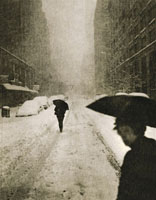
Artist Statement
The result of relishing the role
of the badaud or flaneur, something I do not proclaim,
is merely a description of my lifestyle, which mollifies
my allure of people amid the constant movement of life
in the streets. The temptation of capturing these
fleeting moments without being detected by the subject
matter is my way of seeing people. Most often, I
use people amid scenes as a point of view. However,
landscapes, or even still life’s along the way, come to
the fore as well. The landscapes accent the theme, and
function as a backdrop and theatre with which I move
about, thus casting a reflection of the lure of the
street as a magnetic parcel, which is the foundation of
my work. Glibly playing with focus is my way of not
always clearly defining life in the street, but merely
references the streets as a dream-like oasis; an
unidentifiable place with lures of adventure...
“...In 1853, Sir William J. Newton, a painter, proposed
that the camera could produce artistic results, and the
method he suggested was to use the camera slightly out
of focus, a practice that was to be very controversial
50 years later.”
The
foundation of my work is the result of my respect for
tradition, and my desires to work from a contemporary
perspective within a similar approach of Andre Kertesz,
Henri Cartier-Bresson, Henri Lartigue, Lisette Model,
Paul Strand, Ted Croner, Alexey Brodovitch, William
Klein, Sid Groosman, Louis Faurer, Helen Levit, Roy
Decararva and others. Many of these photographers I’ve
mentioned belonged to, and/or were associated with a
group dubbed The New York School Photographers in mid-
century (the late 1920’s thru the 1960’s in New York and
Paris.)
Far
from what I’d consider Campy, this work is a sincere
reflection of today’s people and aesthetic as part of a
literal reality-the actual face of the glass mirror’s
intention minus any slippery kitsch references, which is
oft unforgivable in many circles, critiques and cliques.
Sometimes there’s information, oft times it’s vague.
While there’s obvious information in the image, I, too,
am captivated by the second read within the not so
obvious shadows, leaving ample room for interpretation
within these shadows and less obvious details one can
find in the photograph later after having traveled
through the characters many times over. It is my opinion
these details live a conscious, yet hidden existence
with a voice for those willing to discover. This is the
beauty of a photograph for me. And while I cannot
provide explanation as to how these details arise, I do
know they persist to present themselves as a common
theme at some point amid the photographic chiaroscuro.
“The
new approach is more sincere. It gets under your skin. I
value shock appeal, but things should be used which
could happen, not things which are obviously posed,
obviously artificial,” said Alexey Brodovitch.
Reality is a cornerstone in my work, so to work in a
fictitious mode, to put it lightly, would be useless.
All of these thoughts have contributed to my lust for
documenting my appreciation of life, and it’s my desire
to maintain a practice that alters the emotions, exists
in reality and has a social relevance, all while
coveting the time we’re living in as an obsession of all
types of faces, styles, lingo, mood, destinations and
independence in our ever changing society. I find it all
very amazing.
For further
information, please contact:
Canada: tel: (1) 604.688.2633,
fax: (1) 604.688.2685
|