|
Exhibitions and Awards
|
2016
|
"The Winter Show", Art Beatus Gallery,
Vancouver, Canada
|
2013
|
"Winterlude", Art Beatus Gallery, Vancouver,
Canada
|
2011
|
Solo Exhibition, Now Contemporary Art
Gallery, Miami, USA
|
|
"Junk Art", Jeju Museum, Jeju, Korea
|
|
"Objects of Everyday Life", Pohang Museum of
Steel Art, Korea
|
2010
|
Solo Exhibition, Galeria nuVEM, São Paulo,
Brazil |
2009
|
"100 Years of Korean Cartoon", National
Museum of Contemporary Art, Gwacheon, Korea
|
|
"Mini em Marte", Uruguay
|
2008
|
"The World of Expression", Seoul Arts
Center, Seoul, Korea
|
|
Solo Exhibition, "Insects", Sangsang Madang,
Seoul, Korea
|
|
ARCO International Art Contemporary Fair,
Madrid, Spain
|
|
Solo Exhibition, Galeria Thomas Cohn, São
Paulo, Brazil |
2007
|
Solo Exhibition,
"may contain SMALL parts", Art Beatus Gallery,
Vancouver, Canada
|
|
Arteamericas, Miami,
USA
|
|
SP Arte, Pavilhão da Bienal de São Paulo,
São Paulo, Brazil |
|
ArteBA, Buenos Aires, Argentina |
|
Mezanino Galeria Thomas Cohn, Galeria Thomas
Cohn, São Paulo, Brazil |
|
2006
|
Arteamericas, Miami, USA |
|
SP Arte, Pavilhão da Bienal de São Paulo,
São Paulo, Brasil |
|
ArteBA, Buenos
Aires, Argentina
|
|
Mezanino Galeria
Thomas Cohn, Galeria Thomas Cohn, São Paulo, Brazil
|
|
"Alice in
Wonderland", Junju Art Center, Korea |
| 2005 |
Arteamericas, Miami, USA |
|
SP Arte, Pavilhão da
Bienal de São Paulo, São Paulo, Brazil |
|
ArteBA, Buenos
Aires, Argentina |
|
Coletiva de artistas Galeria Thomas Cohn,
Galeria Thomas Cohn, São Paulo, Brazil |
| 2004 |
Arte Lisbon 2004 – International Fair of
Contemporary Art, Lisbon, Portugal |
|
Individual Galeria
Thomas Cohn, São Paulo, Brazil
|
| 2003 |
The 2nd Young
Overseas Artists Exhibition, Seoul Arts Center, Korea
|
|
Award from Cannes
Festival – Silver Lion Award for "Vegetable with
Toothpicks", Cannes, France
|
| 2002 |
“Cotidiano”,
Brazilian House Museum, São Paulo, Brazil |
|
Gwangju Biennale,
Gwangju, Seoul, Korea
|
1999
|
Awards from Cannes
Festival, 1 Gold Lion and 2 Silver Lion Awards for the sculptures,
"Food Wood", Cannes, France
|
|
Award Editora Abril,
Brazil |
|
“Rastros, Restos e
Trajetos” – Secretaria Municipal de Cultura, São Paulo,
Brazil |
| 1992 |
Museu de Arte de
Seul, Seoul, Korea |
| 1991 |
Seoul Arts Center,
Seoul, Korea |
| 1990 |
“Formas de Vida” –
Galeria 3, Seoul, Korea |
|
"New Talent" Award
|
Artist
Statement
may
contain SMALL parts
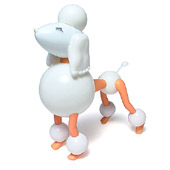
Sang’s works are somewhat popular and even kitsch, and
it is woven out of almost intuitive sense of humor. In
fact, humor is the most important ingredient in his
pieces, where he seems to seek for playful pleasure
capable of stimulating himself in his daily life.
Objects easily at hand in everyday life, especially
plastic dolls, are his prime material. Different
objects, strange to each other, are recombined and
reorganized under the principle of casual interaction,
which produces in turn a strange strain. As a result,
his pieces are at one time familiar and weird, casual
and strained. Is precisely this tension that opens a
“new dimension,” breaking the boundaries of preconceived
perspective.
“Plastic containers, parts of toys, doll’s arms and
legs, screws… all sorts of things surrounding us in our
modern daily life are what I need to make my figures.
This stuff, ordinary and with nothing special, are my
favorites because they belong to my intimate
environment. Plastic is my chosen material because it
gives a modern flavor and a profusion of colors that no
other material seems to offer. So, it relates better
with the “pop dolls” that I seek to materialize.”
“I’d
like to distinguish my work from what is commonly taken
as art under the sign of recycling. The objects that
effectively take part in my pieces have undergone a lot
of reflection and trials in different combinations.
Different objects with their diversity of forms are
gathered in a new kind of rendezvous bringing about a
new thing, although, basically and at first sight, it is
easy to say which objects are there.”
-
Sang Won Sung
For further
information, please contact:
Canada: tel: (1) 604.688.2633,
fax: (1) 604.688.2685
|